> ## Documentation Index
> Fetch the complete documentation index at: https://docs.agentcard.sh/llms.txt
> Use this file to discover all available pages before exploring further.
# Company balance
> Fund your users' cards from one pooled balance, with your billing in the loop
The **company balance** flips the default [user funded](/companies/wallet-funding/user-funded) model: your company prefunds one pooled balance, and when a connected user's agent creates a card, Agentcard moves exactly that card's amount from your pool into the user's spending power. Your users never see a funding step, and you stay in the transaction loop to collect from your own customer first.
The flow of funds is chosen **when you create the company** ([user funded](/companies/wallet-funding/user-funded) or company balance). A company owner can switch models from the dashboard's Company balance page, but only **until the company first moves money** (a card is funded, a transfer runs, or a deposit lands); after that the choice locks. Companies on the company balance model get the full **test-mode** loop immediately and free; **live** usage (the real pool, real transfers) requires an active paid subscription, the same one that unlocks production clients.
## The flow of funds
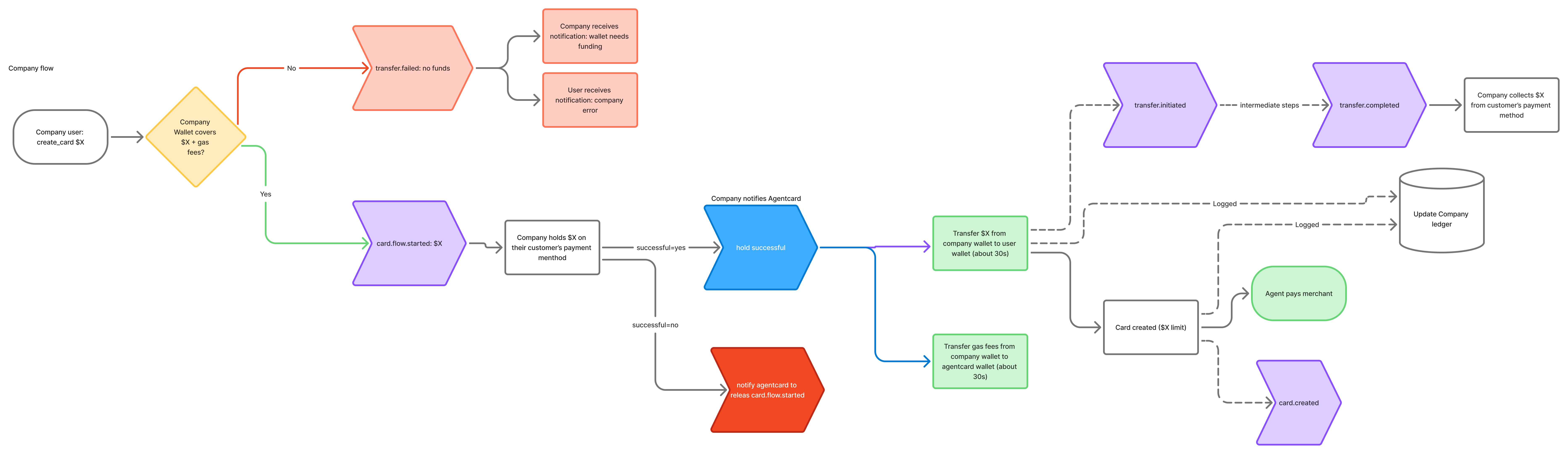 Step by step, for one card:
1. A connected user's agent calls `create_card` with the company flow. Agentcard checks your pool covers the amount (plus fees) and reserves it.
2. You receive a **`card_flow.started`** webhook. This is your moment to collect: place a hold on your customer's payment method in your own billing system.
3. You report the outcome with the `confirm_collection` tool — outcome `succeeded`, or `failed` to release the reservation.
4. Agentcard transfers the amount from your balance into the user's spending power (about 30 seconds on-chain) and emits **`transfer.initiated`**, then **`transfer.completed`**.
5. **Capture your customer's payment when you receive `transfer.completed`.** From this point the funding is final: even if the card mint failed afterward, the money stays as that user's spending power and automatically offsets their next card (you would see `card_flow.failed` with `funds_status: released_to_headroom`).
6. The card mints and **`card.created`** fires with the `transfer_id`, then the agent pays the merchant as usual.
7. If the card closes with unused balance, **`transfer.released`** fires so you can release or refund your own hold. The unused amount stays as that user's spending power and reduces what your pool sends on their next card.
Companies that prefer not to confirm each funding can set `ack_mode: auto_approve` (dashboard or CLI): step 2 still fires as a webhook, but the transfer proceeds without waiting.
## Fund the balance
Set up the balance once (dashboard: **Company balance → Set up balance**, or `agent-cards companies balance provision --org `). Then fund it two ways — both credit the same pool and fire the same **`wallet.funded`** webhook:
* **Apple Pay / Google Pay** (dashboard → **Company balance → Add funds**, admins only). A hosted card checkout — no crypto wallet needed. Any debit or credit card inside Apple/Google Pay works (a Mercury card, for example). First use verifies a US phone with a one-time code, and the payment provider may run a quick identity check on the payer the first time. **$20–$10,000 per transaction**; no lifetime purchase caps. Agentcard covers the provider fee (up to a cap), so the full amount lands.
* **USDC on Base** — send to the pool's deposit address. No caps; this is the rail for recurring, treasury-scale funding.
Deposits are detected automatically. Set a low-balance threshold to get **`wallet.balance.low`** before a card creation ever fails for insufficient funds.
Creating the live pool and funding it both require the active subscription; without one these calls return `403 subscription_required` (test credentials and the mock pool keep working). Subscribe from the dashboard's **Go live** page.
## The create\_card protocol
The end user's agent calls the same `create_card` it always has. Two additions:
* An optional `funds_source` (`onramp_flow` or `company_flow`). Most companies set their **default funds source** to `company_flow` so agents never pass it.
* While funding is in flight, `create_card` returns `202 { "status": "funding_in_progress", "transferId": "owt_…", "retry_after_seconds": 10 }`. The agent retries with the same arguments and attaches to the in-flight funding, returning the card when it is ready. A retry that lands after the mint still returns that card (for about 2 minutes, while it is unused) instead of opening a second funding. Declined or timed-out collections surface as `422 funding_not_approved`.
Server-initiated issuance works too: your backend can call `create_card` itself with `funds_source: "company_flow"`. Your own call counts as the collection confirmation, and passing an `idempotency_key` makes retries attach instead of double-funding. Reusing a key with a different amount or cardholder is rejected with `409 idempotency_key_reuse`; use a fresh key for each new request.
## Balance tools
Available with your company credentials:
| Action | Tool |
| -------------------------------------- | ----------------------------------------------------------------------------------------- |
| Balances, deposit address, settings | `get_company_wallet` |
| List transfers (filter by status) | `list_transfers` |
| Confirm or fail your collection | `confirm_collection` |
| Flow settings (`ack_mode`, thresholds) | Dashboard → **Company balance**, or `agent-cards companies balance settings` |
| Add test funds | Dashboard → **Company balance** (test mode), or `agent-cards companies balance test-fund` |
Transfers move through public states `pending` (substates: `awaiting_collection`, `collection_confirmed`, `transferring`), `funded`, `consumed`, `reclaimed`, and `failed` (with a `failure_reason`).
## Try it in test mode
The whole loop runs in test mode with no real money: fund the mock pool from the dashboard's **Company balance** page (test mode), then run `create_card` with a test credential. The same webhooks fire with `livemode: false`, the transfer simulates in about 2 seconds, and the card is a mock. Integrate the webhook and collection confirmation exactly as you would in production.
## Events
| Event | Fires when | What you do |
| -------------------- | ---------------------------------------------------------------------------------------------------------- | ------------------------------------------------------------ |
| `card_flow.started` | A user's card creation reserved your pool | Hold your customer's payment method, then confirm collection |
| `transfer.approved` | Collection confirmed (by you or auto-approve) | Nothing, informational |
| `transfer.initiated` | The on-chain transfer was submitted | Nothing, informational |
| `transfer.completed` | Funds are the user's spending power | **Capture your customer's payment** |
| `card.created` | The card minted (includes `transfer_id`) | Final confirmation |
| `transfer.failed` | Funding aborted before the card (`insufficient_org_funds`, `ack_timeout`, `ack_denied`, `transfer_failed`) | Release your hold |
| `card_flow.failed` | Mint failed after funds moved (`funds_status: released_to_headroom`) | Keep your capture, the user keeps the spending power |
| `transfer.released` | Card closed or expired with unused balance | Release or refund your own hold |
| `wallet.funded` | A deposit landed in your pool | Reconcile your treasury |
| `wallet.balance.low` | The pool dropped under your threshold | Top up |
Step by step, for one card:
1. A connected user's agent calls `create_card` with the company flow. Agentcard checks your pool covers the amount (plus fees) and reserves it.
2. You receive a **`card_flow.started`** webhook. This is your moment to collect: place a hold on your customer's payment method in your own billing system.
3. You report the outcome with the `confirm_collection` tool — outcome `succeeded`, or `failed` to release the reservation.
4. Agentcard transfers the amount from your balance into the user's spending power (about 30 seconds on-chain) and emits **`transfer.initiated`**, then **`transfer.completed`**.
5. **Capture your customer's payment when you receive `transfer.completed`.** From this point the funding is final: even if the card mint failed afterward, the money stays as that user's spending power and automatically offsets their next card (you would see `card_flow.failed` with `funds_status: released_to_headroom`).
6. The card mints and **`card.created`** fires with the `transfer_id`, then the agent pays the merchant as usual.
7. If the card closes with unused balance, **`transfer.released`** fires so you can release or refund your own hold. The unused amount stays as that user's spending power and reduces what your pool sends on their next card.
Companies that prefer not to confirm each funding can set `ack_mode: auto_approve` (dashboard or CLI): step 2 still fires as a webhook, but the transfer proceeds without waiting.
## Fund the balance
Set up the balance once (dashboard: **Company balance → Set up balance**, or `agent-cards companies balance provision --org `). Then fund it two ways — both credit the same pool and fire the same **`wallet.funded`** webhook:
* **Apple Pay / Google Pay** (dashboard → **Company balance → Add funds**, admins only). A hosted card checkout — no crypto wallet needed. Any debit or credit card inside Apple/Google Pay works (a Mercury card, for example). First use verifies a US phone with a one-time code, and the payment provider may run a quick identity check on the payer the first time. **$20–$10,000 per transaction**; no lifetime purchase caps. Agentcard covers the provider fee (up to a cap), so the full amount lands.
* **USDC on Base** — send to the pool's deposit address. No caps; this is the rail for recurring, treasury-scale funding.
Deposits are detected automatically. Set a low-balance threshold to get **`wallet.balance.low`** before a card creation ever fails for insufficient funds.
Creating the live pool and funding it both require the active subscription; without one these calls return `403 subscription_required` (test credentials and the mock pool keep working). Subscribe from the dashboard's **Go live** page.
## The create\_card protocol
The end user's agent calls the same `create_card` it always has. Two additions:
* An optional `funds_source` (`onramp_flow` or `company_flow`). Most companies set their **default funds source** to `company_flow` so agents never pass it.
* While funding is in flight, `create_card` returns `202 { "status": "funding_in_progress", "transferId": "owt_…", "retry_after_seconds": 10 }`. The agent retries with the same arguments and attaches to the in-flight funding, returning the card when it is ready. A retry that lands after the mint still returns that card (for about 2 minutes, while it is unused) instead of opening a second funding. Declined or timed-out collections surface as `422 funding_not_approved`.
Server-initiated issuance works too: your backend can call `create_card` itself with `funds_source: "company_flow"`. Your own call counts as the collection confirmation, and passing an `idempotency_key` makes retries attach instead of double-funding. Reusing a key with a different amount or cardholder is rejected with `409 idempotency_key_reuse`; use a fresh key for each new request.
## Balance tools
Available with your company credentials:
| Action | Tool |
| -------------------------------------- | ----------------------------------------------------------------------------------------- |
| Balances, deposit address, settings | `get_company_wallet` |
| List transfers (filter by status) | `list_transfers` |
| Confirm or fail your collection | `confirm_collection` |
| Flow settings (`ack_mode`, thresholds) | Dashboard → **Company balance**, or `agent-cards companies balance settings` |
| Add test funds | Dashboard → **Company balance** (test mode), or `agent-cards companies balance test-fund` |
Transfers move through public states `pending` (substates: `awaiting_collection`, `collection_confirmed`, `transferring`), `funded`, `consumed`, `reclaimed`, and `failed` (with a `failure_reason`).
## Try it in test mode
The whole loop runs in test mode with no real money: fund the mock pool from the dashboard's **Company balance** page (test mode), then run `create_card` with a test credential. The same webhooks fire with `livemode: false`, the transfer simulates in about 2 seconds, and the card is a mock. Integrate the webhook and collection confirmation exactly as you would in production.
## Events
| Event | Fires when | What you do |
| -------------------- | ---------------------------------------------------------------------------------------------------------- | ------------------------------------------------------------ |
| `card_flow.started` | A user's card creation reserved your pool | Hold your customer's payment method, then confirm collection |
| `transfer.approved` | Collection confirmed (by you or auto-approve) | Nothing, informational |
| `transfer.initiated` | The on-chain transfer was submitted | Nothing, informational |
| `transfer.completed` | Funds are the user's spending power | **Capture your customer's payment** |
| `card.created` | The card minted (includes `transfer_id`) | Final confirmation |
| `transfer.failed` | Funding aborted before the card (`insufficient_org_funds`, `ack_timeout`, `ack_denied`, `transfer_failed`) | Release your hold |
| `card_flow.failed` | Mint failed after funds moved (`funds_status: released_to_headroom`) | Keep your capture, the user keeps the spending power |
| `transfer.released` | Card closed or expired with unused balance | Release or refund your own hold |
| `wallet.funded` | A deposit landed in your pool | Reconcile your treasury |
| `wallet.balance.low` | The pool dropped under your threshold | Top up |